Heat Transfer
Physics Grade 1
Introduction
Hello student, today we are going to discover what is heat. Heat is everywhere in our daily life and we need to know what is hot or not to prevent getting burned. We also make use of transfering heat from one place to another in a smart way. In the next grade we learn about the transfer.
This lesson will take about 1 hour and at the end of this lesson you can do some exercises. Alone, with a teacher or with a group of students. Don't worry. These exercises are not dangerous.
NOTE: If you do not understand the theory, just read it again or ask a teacher or fellow student. Asking questions is never dumb, but always smart!
Theory and Questions
What is Heat?
So we discuss the term heat and heat transfer.
Heat is defined as 1) Making something hot or warm, 2) Something having a high temperature.
Definitions are a great to way to really understand difficult words goods. So try to remember this definition.
You can write the down the definition and try read it out loud. And do this a couple of times. In this way you learn to remember it.
Remembering the picture you see here might also help.
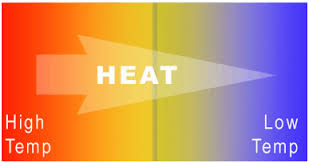
This picture shows that Red is a color used to indicate something has a high tempreature. And the color Blue is used to indicate something has a low tempreature.
If something is hot, it is has a (relatively) high temperature. If something is called cold, it has (relatively) a low temperature. To be heating something up, is making it warmer. If something is heated it has a high temperature.
Can you think of three examples of heat? And maybe ask a family member of a friend if they now examples of heat?
What can be hot or not?
Now follow some question to learn what can and cannot have heat:
1) Can water get hot? And can water get cold?
2) Can food get hot? And can food get cold?
3) Can sand at the beach get hot? And can sand at the beach get cold?
4) Can the day be hot and the night be cold?
5) Chances are you know the answer to many of these questions. But now we are going to learn how they can become hot and cold. And why and how we make use of that in many things we use in our daily life.
Now follow slightly different questions and maybe hard questions to answer. But you can discuss it with other class mates:
1) Suppose you have a cup of hot tea and you want the water to stay hot. What do you do?
2) Suppose you have an icecream dessert and you want to keep it very cold for a long time. What do you do?
3) Suppose you are at the beach and the sand is too hot for your bare feet to walk on. What do you do?
4) Why do people in countries close to the equator, like Suriname, hardly wear jackets?
Exercises
Now you are going to do some exercises to get known with heat.
1) Rub your hand for some time on your arm or leg. You will experience that is gets warm. And if you stop after sometime it is colder again.
You have now done a physcis experiment. Your body is made of cells and the cells consists of very parts called molecules.
If you rub your hands, you caus the molecules in your hands to go move faster. And if molecules move faster, they higher their temperature.
2) Get ice cubes from a fridge.
Take three glasses: 1 your keep empty and the second one you fill with water of room temperature and the third you fill with very cold water.
Now wait for 1 hour. And see what has happened. Can you see the difference?
3) Now do the experiment we did before but now with ice cubes in a glass with water with salt and ice cubes in a glass with water without salt (fresh water).

In the picture above 2 icecubes are frozen together with a colored liquid and put in a glass with freshwater (left) and salt water (right). When the ice cubes start melting you see how different the freshwater and salt water glass mix the ice cube water. The ice cube in salt water melts much slower.
With these experiments you test that heat is transfered from a colder place to a hotter place and vice versa. In the next grade we will learn how this works.
Know that for experiments to be valuable and trustworthy you must repeat them constantly under the same circumstances.
Thank you for doing this Physics lessons of Heat Tranfer. See you again next time.